Customer Relationship Management is no longer optional for companies that want to scale. In a market where customer expectations rise every year, businesses that fail to organize and use customer data effectively lose deals, waste marketing budget, and struggle with retention.
A modern CRM system gives teams a clear view of every customer interaction and turns that information into revenue. This article explains how CRM software actually drives growth and what companies need to focus on to get real results.
The Real Purpose of a CRM
At its core, a CRM exists to solve one major problem: scattered customer information. When sales, marketing, and support teams work with different tools and incomplete data, the customer experience becomes inconsistent and opportunities are lost.
A well-implemented CRM creates a single source of truth. Every email, call, meeting, purchase, and support ticket is recorded and accessible. This allows any team member to understand the full history of a customer in seconds.
How CRM Directly Impacts Revenue
Companies that use CRM systems effectively usually see measurable improvements in several key areas:
- Higher conversion rates from lead to customer
- Increased average deal size
- Better sales forecasting accuracy
- Reduced customer churn
- Improved marketing campaign performance
Sales teams stop wasting time on unqualified leads. Marketing teams can target the right audience with the right message. Support teams resolve issues faster because they have full context.
Essential CRM Capabilities for High Performance
Not every CRM delivers the same value. The platforms that produce the strongest results share these characteristics:
Complete Contact Management Every customer and prospect is stored with detailed information, communication history, and activity tracking.
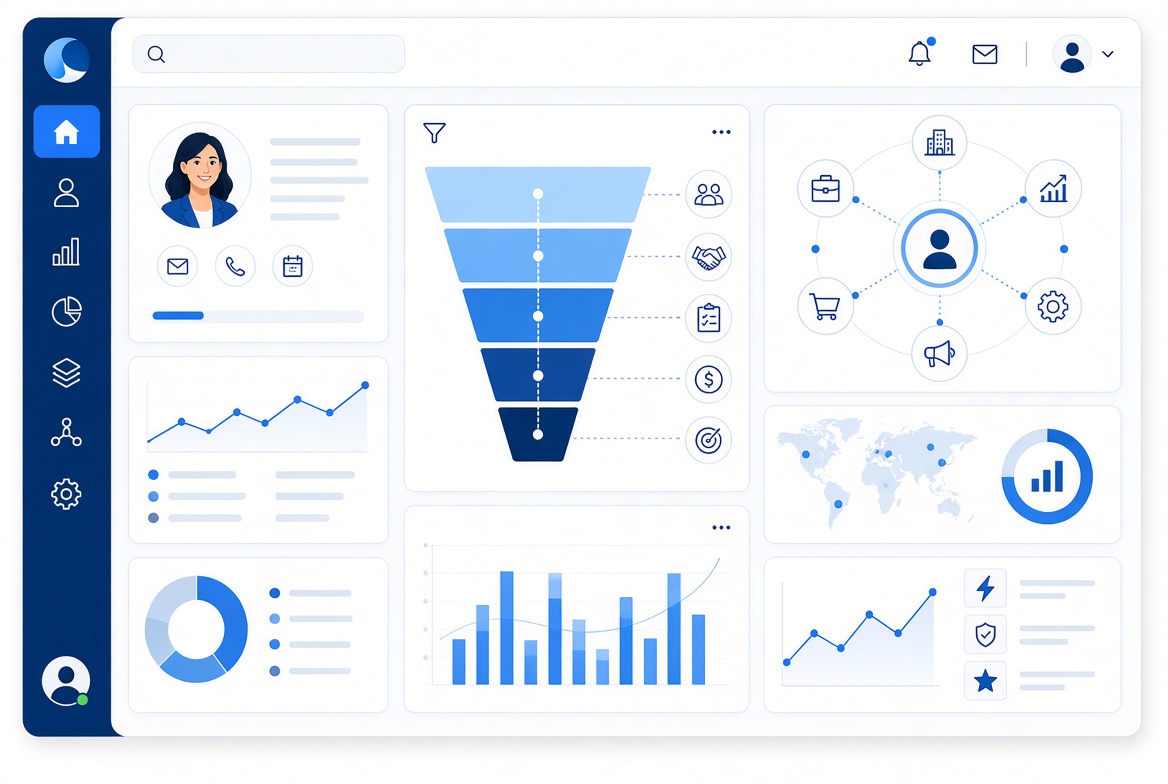
Visual Sales Pipeline Managers and representatives can see exactly where each deal stands and what actions are required to move it forward.
Workflow Automation Repetitive tasks such as follow-up emails, lead assignment, and task creation are handled automatically.
Reporting and Analytics Clear dashboards show performance metrics in real time, helping leadership make better decisions.
Strong Integrations The CRM must connect smoothly with email, calendar, marketing automation, accounting, and customer support tools.
CRM as a Sales Acceleration Tool
For sales teams, a CRM is more than a database. It becomes a daily operating system. Representatives can prioritize the most promising opportunities, receive automatic reminders, and access customer insights before every call.
Managers gain visibility into team performance and can coach more effectively. Forecasting becomes more reliable because the data is consistent and up to date.
Aligning Sales and Marketing Through CRM
One of the most powerful benefits of a CRM is the ability to align sales and marketing. When both teams work from the same platform:
- Marketing generates higher-quality leads
- Sales receives better context about each prospect
- Both departments measure success with shared metrics
This alignment reduces internal friction and increases overall revenue efficiency.
Common Reasons CRM Projects Fail
Many organizations invest in CRM software but fail to see results. The most common reasons include:
- Lack of clear processes before implementation
- Poor user adoption due to insufficient training
- Excessive customization that makes the system complicated
- Low data quality
- No executive sponsorship
A CRM only works when the entire team uses it consistently and leadership treats it as a critical business system.
The Role of Artificial Intelligence in Modern CRM
Artificial intelligence is changing how CRM platforms operate. Today’s leading systems offer features such as:
- Predictive lead scoring
- Automated email suggestions
- Conversation analysis
- Churn risk prediction
- Personalized customer recommendations
These capabilities help teams work faster and focus on the highest-value activities.
Final Thoughts
A CRM system is one of the highest-return investments a growing company can make. When implemented with clear processes and strong adoption, it improves sales performance, marketing efficiency, and customer retention at the same time.
Businesses that treat customer data as a strategic asset and build their operations around a solid CRM platform are better positioned to grow in competitive markets.
The question is no longer whether a company needs a CRM. The real question is how effectively it will use one.